For many Wix sellers, the appeal of dropshipping is obvious: no upfront inventory costs, no warehousing to manage, and full focus on marketing and sales. However, when most Wix sellers look toward mainstream apps, a more flexible and cost-competitive option is often overlooked — dropshipping shipped directly from China.
FBC (Fulfillment by China) is a fulfillment provider built precisely for this need. It offers Wix sellers dropshipping fulfillment support with direct shipping from China to customers worldwide, covering core services such as order processing, international shipping, and eCommerce fulfillment. This article starts from the real pain points Wix sellers face and systematically explains how to build a lean, efficient dropshipping operation through FBC.
Why Wix Sellers Should Pay Attention to China Direct Shipping Dropshipping
Wix Stores itself provides a fairly complete dropshipping infrastructure. Sellers can connect with fulfillment providers through the Wix App Market, select products, push them to their store, and have suppliers ship directly once orders come in. This system works smoothly for selling products sourced from Western suppliers.
But here's the problem: what if the product categories you want to sell have their supply chain advantage in China? Electronics accessories, fashion jewelry, creative home goods, party supplies, phone cases — these categories have the world's most concentrated manufacturing resources and the most competitive price ranges in China. Wix's mainstream dropshipping options are dominated by Western suppliers, and their product selection and cost structures often cannot cover these categories.
This means a Wix seller who wants to sell these categories faces a real choice: either give up the category advantage, or step outside Wix's dropshipping ecosystem and handle everything from sourcing in China to international shipping themselves — the latter being an almost unbearable operational burden for individual sellers.
FBC's value lies in filling this gap.
FBC's Dropshipping Model: What It Does and What It Doesn't
To understand FBC's positioning, the key is to distinguish it from the functional boundaries of Wix's built-in dropshipping options.
Mainstream dropshipping platforms focus on "product discovery and pushing": they connect a large number of suppliers, and sellers select products, set prices, push them to their store, and have the platform coordinate supplier shipping once orders come in. Print-on-demand providers focus on the print-on-demand category, where sellers upload designs and suppliers produce and ship to order.
FBC does not do product discovery, does not run a marketplace, and does not offer design tools. What it focuses on is the "second half" of dropshipping: once a Wix seller has determined what products to sell, FBC handles the entire process of picking, packing, international shipping, and logistics tracking from its China warehouse. Its service combination — China Warehouse, Order Fulfillment, International Shipping, eCommerce Fulfillment, Dropshipping Fulfillment — clearly points to one positioning: fulfillment infrastructure for the China supply chain.
For Wix sellers, this means you can continue using Wix as your sales front end while outsourcing the complexity of international logistics to FBC. You don't need to learn how to connect to a Chinese supplier's shipping system, don't need to handle international shipping labels, and don't need to manually track cross-border logistics status.
How Wix Sellers Work with FBC
Wix Stores' order management functionality provides a natural foundation for this collaboration. In the Wix dashboard, you can view the status of all orders and manage the shipping process. When an order comes in, what the Wix seller needs to do is pass the order information to FBC, which handles the actual shipping.
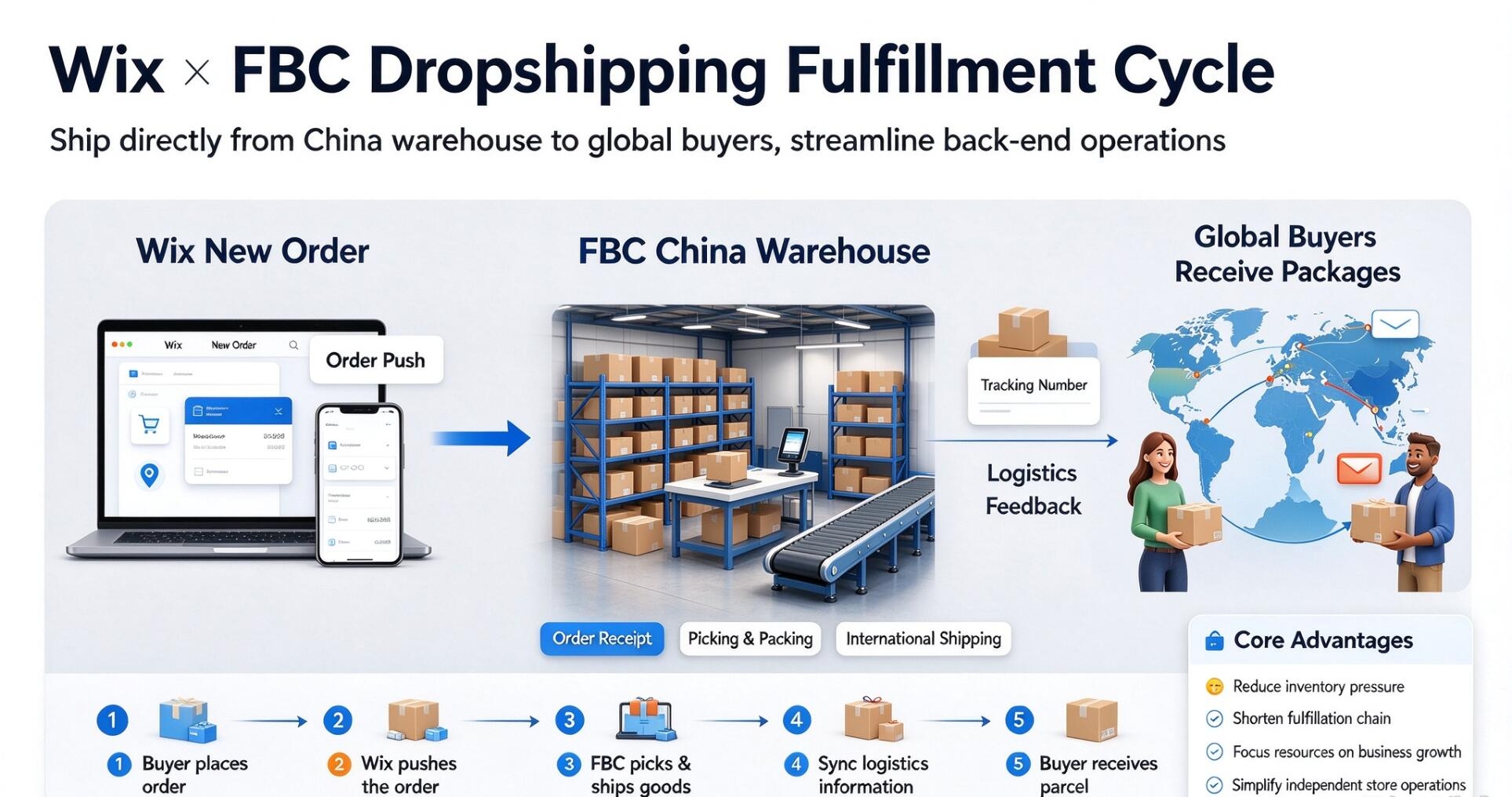
The specific process can be broken down into the following steps:
Step 1: Product and inventory coordination. The Wix seller determines the categories and specific products to sell, and confirms inventory availability at FBC's China warehouse. FBC's China Warehouse service means products can be stored within China, ready to ship at any time.
Step 2: Order information transfer. When a Wix store generates an order, the seller provides the order details (product, quantity, shipping address) to FBC. Depending on FBC's integration method, this step can be completed through its system rather than relying on automatic integration within the Wix App Market.
Step 3: FBC fulfillment and shipping. FBC completes picking and packing at its China warehouse and ships the package to customers worldwide via International Shipping. This process covers international transportation, customs coordination, and last-mile delivery.
Step 4: Tracking synchronization. FBC provides a tracking number, which the seller can add to the Wix order so the customer can view logistics status on Wix's order tracking page. Wix supports third-party fulfillment providers updating tracking information, which makes manual synchronization or API integration feasible.
To be clear: since FBC does not offer a one-click integration in the Wix App Market, sellers need to transfer order information manually or semi-automatically. This is an operational reality to accept when choosing China direct shipping dropshipping — compared to a "zero-operation" experience, it adds one step of order transfer. But for sellers who want to benefit from the China supply chain, this step buys category flexibility and cost advantages, which is usually worth it.
Pricing and Profit Margins: The Math Wix Sellers Need to Get Right
Regardless of which dropshipping model you use, profit always depends on a basic formula: Target selling price = Product cost + Shipping + Platform and payment fees + Advertising cost + Desired profit. Built-in dropshipping tools typically provide pricing rule tools, for example, a default markup of 1.67x product cost.
When using FBC for China direct shipping dropshipping, Wix sellers need to calculate pricing themselves. This brings some flexibility, but also more responsibility. Products sourced from China usually cost significantly less than from Western suppliers, but international shipping must be factored in. For lightweight, small-volume categories (such as jewelry, phone accessories, small home goods), unit shipping costs are manageable, and profit margins are often more attractive than Western-supplier dropshipping. For heavy or bulky items, shipping costs need to be carefully calculated against profit erosion.
A practical approach: start with 3-5 test products, calculate the full cost from FBC shipping to your main target markets (US, Europe, Australia), then compare with your Wix store pricing to verify whether the profit model holds. Clearly display estimated delivery times on product pages to manage customer expectations — this reduces after-sales disputes more effectively than vaguely promising "fast shipping."
Which Wix Sellers Are Best Suited for FBC Dropshipping
Not every Wix seller is suited to this path. The following types may benefit most clearly:
Category-driven sellers. If you already know which category you want to sell and that category's supply chain advantage is in China, FBC offers a way to directly convert that advantage into store competitiveness. You don't have to give up your category choice because Wix's built-in options lack relevant products.
Sellers transitioning from marketplaces to independent stores. Many sellers who have used Chinese suppliers for shipping on Amazon, AliExpress, or TikTok Shop are already familiar with this fulfillment model. When they extend their business to a Wix independent store, FBC allows them to reuse existing supply chain relationships without rebuilding their logistics system.
Small-scale sellers testing new categories. For Wix sellers who haven't yet finalized their category, the China direct shipping model allows testing multiple categories with lower inventory risk. You don't need to send inventory to an overseas warehouse first as you would with a 3PL — instead, you can optimize your fulfillment approach gradually after confirming category demand.
Sellers with some operational capability. Since FBC does not provide one-click integration in the Wix App Market, sellers need basic capabilities to handle order transfer, tracking synchronization, and similar operational steps. For sellers with zero operational experience, starting with simpler built-in options may be easier.
Before You Start: A Practical Checklist for Wix Sellers
If you decide to try China direct shipping dropshipping through FBC, the following preparation steps can help you launch more smoothly:
Set up and configure Wix Stores. Make sure your Wix website has eCommerce functionality enabled, and can display products, receive orders, and manage inventory.
Determine your initial category and products. Don't spread across a large number of products at once. Choose 15-25 focused SKUs around a clear category positioning, rather than randomly assembling a product catalog.
Confirm collaboration details with FBC. Clarify FBC's order transfer method, shipping timelines, tracking number delivery method, supported destination countries, and shipping cost calculation rules.
Set up shipping rules in Wix. Wix's shipping settings do not automatically synchronize with third-party fulfillment providers' rates. You need to create corresponding shipping rules in the Wix dashboard based on FBC's shipping references. Consider setting up a separate shipping profile for dropshipping products to distinguish rates from self-fulfilled products.
Create a clear shipping policy. Display estimated delivery times, shipping regions, and return instructions on product pages and in the checkout flow. Cross-border direct shipping usually takes longer than domestic shipping — managing expectations upfront is more effective than apologizing afterward.
Place a test order. Before officially promoting, run a real order through the entire process: place an order on Wix, transfer it to FBC, track the shipment, and confirm the customer receives the package. This helps you identify friction points in the process and resolve them before scaling.
Conclusion
Wix's dropshipping ecosystem is already quite mature, offering sellers a low-barrier starting path. But the cost of a mature ecosystem is convergence in categories and supply chains — when everyone is selling similar products from similar suppliers, differentiation becomes increasingly difficult.
FBC represents another choice: it doesn't try to be just another dropshipping marketplace, but focuses on the fulfillment capabilities of the China supply chain. For sellers who want to combine China's manufacturing advantages with Wix's site-building freedom, this path offers a possibility — within the Wix ecosystem, making product choices that only you can make.
The cost is one extra step of order transfer and the absence of seamless app market integration. But for sellers who truly understand their category advantage, this step may buy the foundation of their entire store's competitiveness.