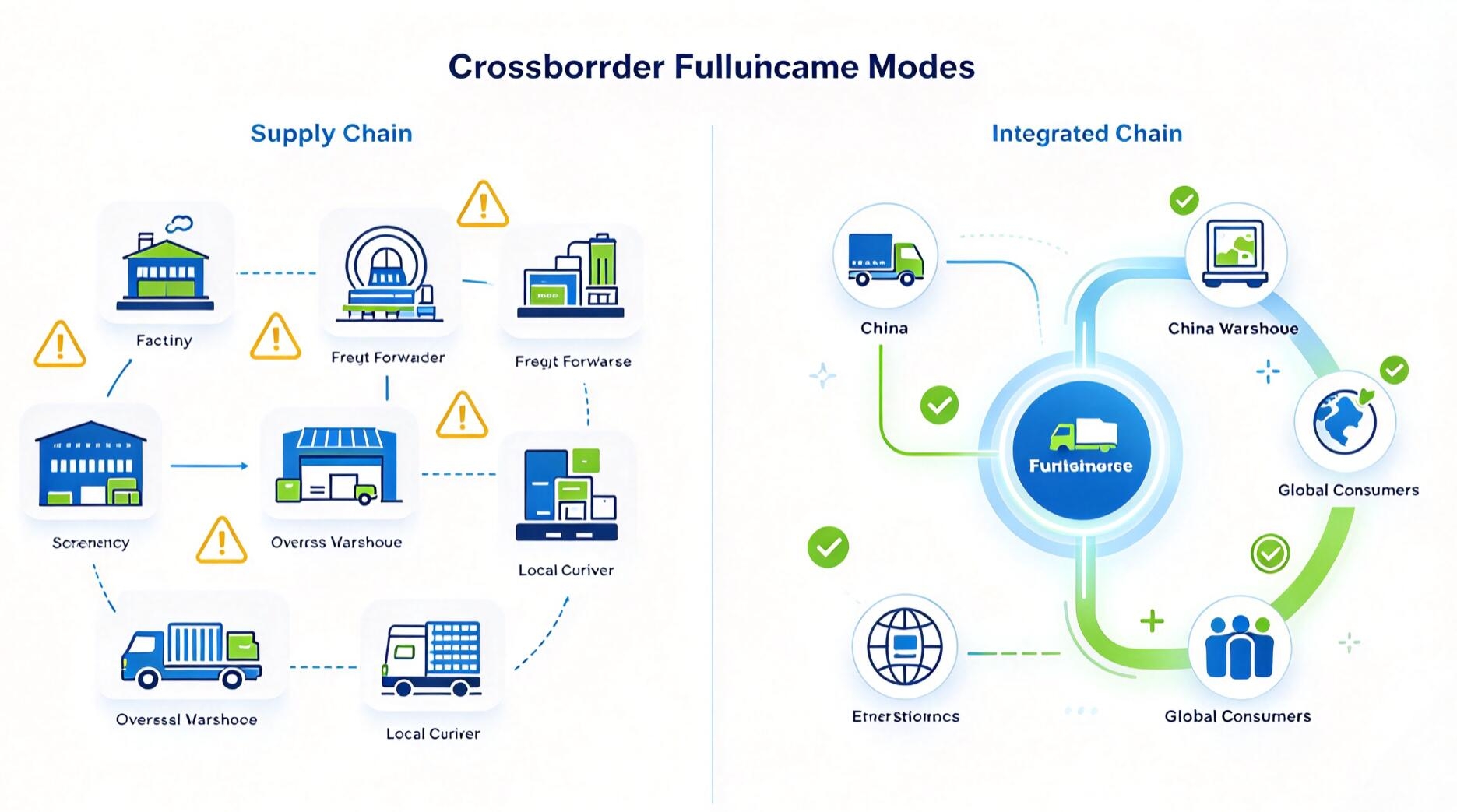
For Chinese sellers using Magento to expand into global markets, fulfillment capability is replacing traffic acquisition as the core bottleneck constraining growth. When your Magento store receives an order from the US, Europe, or Southeast Asia, whether you can deliver the product to the consumer at a controllable cost and with stable lead times directly determines your repurchase rate and brand reputation.
FBC (Fulfillment by China) is a cross-border fulfillment system built to solve exactly this pain point. Although the target website you provided could not be accessed directly at this time, based on publicly available industry information and cross-border logistics practices, we can clearly see that the essence of FBC is integrating China-origin warehousing, export customs clearance, cross-border transportation, and overseas last-mile delivery into a complete "two warehouses, one line" chain. For Magento sellers, this means you no longer need to separately connect with factories, freight forwarders, overseas warehouses, and local couriers. Instead, through a unified fulfillment interface, you can complete the entire delivery process from the "China warehouse" to global consumers.
Supply Chain Front-Loading: Moving the "Overseas Warehouse" to the Doorstep of the Source
Under the traditional cross-border model, the biggest financial pressure Magento sellers face comes from "heavy inventory bets"—they must ship large quantities of goods to overseas warehouses in destination countries in advance. If sales fall short of expectations, inventory accumulation and storage fees become a heavy burden. The core logic of FBC is to front-load inventory to the Chinese source of supply. Sellers only need to store products in FBC's domestic warehouse, and then, based on actual sales orders from their Magento store, trigger on-demand dropshipping or batch replenishment to overseas warehouses.
The direct benefit of this model is a significant reduction in capital occupation. You no longer need to stock separately for each target market. Instead, you use a single Chinese inventory pool to cover global orders. For Magento sellers operating multiple stores and multiple sites, this means a substantial improvement in inventory turnover—the same batch of inventory can flexibly respond to sales fluctuations in different regions instead of being "locked" in a single overseas warehouse.
Fulfillment Certainty: Controllable Lead Times, Transparent Tracking
What Magento sellers fear most is not "slowness" but "uncertainty." If logistics information does not update for a long time after a consumer places an order, the customer service team will be flooded with "Where is my package?" inquiries. Research shows that clear tracking notifications can significantly reduce customer service inquiries while improving customer reviews.
Under the FBC system, the fulfillment chain has clear node control: domestic warehouse orders are processed the same day, and inbound and outbound processes are standardized; the cross-border segment relies on fixed air, sea, or dedicated line resources; the overseas segment completes last-mile delivery through partner warehouses. For Magento sellers, this means the logistics status of every order can be transmitted back to the store backend through the system, and consumers can view full tracking information directly within the Magento site without jumping to a third-party website. This increase in transparency translates directly into lower customer service costs and higher customer trust.
From "Single-Point Integration" to "Systematic Fulfillment": Technical Fit for Magento Sellers
As an API-first e-commerce platform, Magento is naturally suited for deep integration with external fulfillment systems. FBC-type services usually provide standardized order synchronization and inventory update interfaces. Through extensions or middleware, Magento sellers can achieve:
Automatic order transmission: After an order is generated in the Magento store, it is automatically synchronized to the FBC warehousing system, with no manual export or import required;
Real-time inventory feedback: Available inventory in the FBC domestic warehouse is updated in real time in the Magento backend to avoid overselling;
Automatic tracking number writing: After shipment, the tracking number is automatically transmitted back to the Magento order details page, triggering shipment notification emails.
This systematic integration approach allows sellers to focus their energy on product selection and marketing rather than getting stuck in the quagmire of "manually processing orders." As Boots' experience in the Dutch market proves: order growth brought by automated fulfillment processes can be achieved without increasing headcount.
Global Warehouse Network: Not Just "Shipping Out," but "Selling In"
FBC's "global fulfillment" capability is reflected not only at the logistics level but also in its localization fit for target markets. Taking the overseas warehouse nodes in the FBC system as an example, they are usually deeply integrated with local e-commerce platforms, payment methods, and delivery networks, supporting value-added services such as dropshipping and local returns and exchanges.
For Magento sellers, this means you can manage orders shipped to different countries from a single backend, while consumers in each market enjoy a "local shipping" delivery experience. Whether it is the Lazada and Shopee ecosystems in Southeast Asia or local delivery networks in the Middle East and Europe, FBC's overseas nodes are minimizing the traces of "cross-border." When consumers cannot perceive the existence of "cross-border," conversion rates and repurchase rates naturally increase.
Cash Flow Advantage: Delayed Tariffs and Flexible Replenishment Rhythm
Cross-border sellers often have a common misconception: sales growth equals healthy operations. In reality, if all funds are tied up in FBA or overseas warehouse inventory, the profit on the books is only "goods," not "money." The FBC model, through delayed destination-country tariff payment and small-batch, high-frequency replenishment, gives Magento sellers more flexible cash flow. You can maintain safety stock in the Chinese warehouse first and gradually transfer goods based on actual sales data, rather than paying overseas storage fees and tariffs in one lump sum before sales are validated.
Conclusion
For Magento sellers, choosing FBC is not simply "switching to another logistics provider"—it is transforming fulfillment from a cost center into a growth lever. When your Magento store can serve global consumers with lower capital occupation, more stable lead times, more transparent tracking, and more flexible localization solutions, you effectively gain an operational barrier that competitors cannot easily replicate. Competition in the supply chain will ultimately be reflected in the delivery experience of every single package. What FBC provides is precisely a deterministic channel from the Chinese source of supply directly to global consumers.